
HEPA Filters Explained: H13 vs True HEPA
Not all HEPA filters are equal. H13 captures 99.97% of particles at 0.3 microns, while 'True HEPA' is a marketing term with no fixed standard. Here is what the grades actually mean for Malaysian air quality.
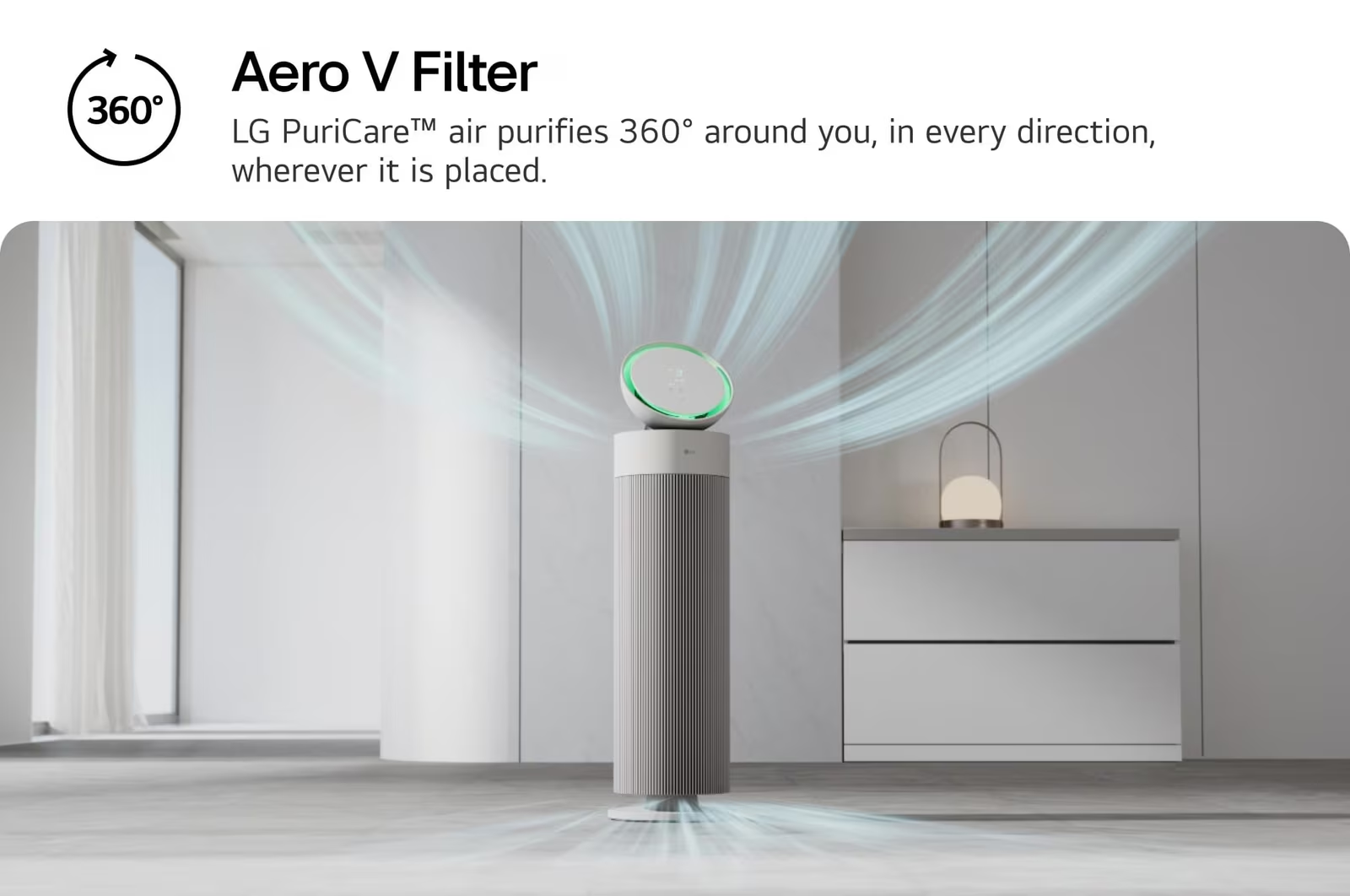
If you are shopping for an air purifier in Malaysia, you have probably seen the terms H13 HEPA, True HEPA and HEPA-type on product listings. They sound similar, but the differences matter — especially during haze season when PM2.5 levels in the Klang Valley can spike above 100 ug/m3 within hours. This post explains what each HEPA grade actually means and why it should influence your buying decision.
What HEPA stands for
HEPA stands for High Efficiency Particulate Air. It is a filtration standard, not a brand name. The standard was originally developed in the 1940s for nuclear research facilities that needed to capture radioactive dust particles from the air.
Today, HEPA filters are graded by the European standard EN 1822, which classifies them from E10 (the lowest efficiency) through H14 (the highest commonly used in consumer and medical applications). The grade tells you two things: the minimum particle size the filter can capture, and the percentage of those particles it stops.
The HEPA grades that matter for home use
| Grade | Efficiency at 0.3 microns | Typical use |
|---|---|---|
| E11 | 95% | Basic industrial filtration |
| E12 | 99.5% | Some budget air purifiers |
| H13 | 99.97% | Premium air purifiers, hospitals |
| H14 | 99.995% | Clean rooms, surgical theatres |
The jump from E12 to H13 is significant. An E12 filter lets through 5 out of every 1,000 particles at the most penetrating particle size (0.3 microns). An H13 filter lets through only 0.3 out of every 1,000. In a room with heavy haze infiltration, that difference translates to measurably cleaner air.
H14 is overkill for residential use. The filter media is denser, which increases resistance and requires more powerful fans — driving up noise and energy consumption. H13 is the sweet spot for home air purifiers.
What is "True HEPA" then
Here is where the confusion starts. "True HEPA" is not an official grade under EN 1822 or any other international standard. It is a marketing term used primarily in North America to distinguish filters that meet or exceed H13-equivalent performance from cheaper "HEPA-type" or "HEPA-style" filters that do not.
When a manufacturer labels a filter "True HEPA," they are usually claiming it meets the US DOE standard of 99.97% efficiency at 0.3 microns — which is functionally equivalent to H13. But because "True HEPA" has no legally enforced definition in Malaysia, some brands use it loosely. A filter labelled "True HEPA" might be H13-equivalent, or it might be E12 with optimistic marketing.
The safest approach: look for the explicit H13 grade. If the product page or spec sheet does not state H13 (or EN 1822 compliance), assume it is not.
What is "HEPA-type" or "HEPA-style"
These terms are red flags. A "HEPA-type" filter looks like a HEPA filter — it has pleated media in a frame — but it does not meet any recognised HEPA efficiency standard. Typical efficiency is 85-95% at 0.3 microns, which means it lets through 50 to 150 particles for every 1,000. That is adequate for large dust particles but insufficient for PM2.5 haze particulates.
If your primary concern is haze season protection, cooking fume particles, or allergen reduction, a HEPA-type filter will not deliver the results you expect.
Why 0.3 microns is the benchmark
You might wonder why HEPA efficiency is measured at 0.3 microns specifically. This size is called the Most Penetrating Particle Size (MPPS). Particles larger than 0.3 microns are easier to catch because they collide with filter fibres through inertial impaction. Particles smaller than 0.3 microns are easier to catch because they move erratically (Brownian motion) and stick to fibres through diffusion.
At 0.3 microns, neither mechanism is dominant — the particle is too small for reliable inertial capture and too large for efficient diffusion. This is the hardest size for any mechanical filter to catch. If a filter achieves 99.97% efficiency at 0.3 microns, it performs even better at all other sizes.
For context, PM2.5 haze particles range from 0.1 to 2.5 microns. An H13 filter handles the full range, including the most difficult 0.3-micron fraction.
How H13 applies to Malaysian air quality
Malaysia faces three recurring indoor air quality challenges, and H13 HEPA addresses all three.
Haze season (June to October). Transboundary haze from agricultural burning pushes PM2.5 levels into the unhealthy range across the Klang Valley, Johor and Sarawak. H13 filtration reduces indoor PM2.5 from 50-80 ug/m3 to below 10 ug/m3 within 30 minutes in a sealed room.
Year-round dust and allergens. Malaysia's humidity promotes dust mite populations. Their allergenic faecal particles (2.5-10 microns) are well within H13 capture range. Mould spores (2-20 microns) and pollen (10-100 microns) are captured with even greater efficiency.
Cooking fumes in open-plan homes. Fine oil droplets from wok cooking are typically 0.5-5 microns. H13 captures these particles effectively, though an activated carbon layer is also needed to handle the gaseous odour component.
LG PuriCare models that use H13 HEPA
Every air purifier in the LG PuriCare range uses H13-grade HEPA filtration as a minimum. Here is a summary.
| Model | Filter type | Coverage | From |
|---|---|---|---|
| 360 HIT | H13 HEPA + Deodorising | 61.2 m2 | RM50/mo |
| AeroFurniture | H13 HEPA + UVnano | 19.8 m2 | RM60/mo |
| AeroBooster | Dual H13 HEPA + UVnano | 52.8 m2 | RM65/mo |
| AeroCatTower | H13 HEPA | — | RM70/mo |
| Alpha Pet Single | V-Pet H13 HEPA | 61.2 m2 | RM75/mo |
| Alpha Pet Double | 2x V-Pet H13 HEPA | 104 m2 | RM105/mo |
The AeroBooster is also BAF (British Allergy Foundation) certified, which provides independent third-party verification that the unit reduces airborne allergens effectively. If you are choosing between models based on filtration credibility, the BAF certification is a concrete differentiator.
How to verify a filter is genuinely H13
Three checks you can do before buying any air purifier, regardless of brand.
Check the spec sheet for EN 1822 compliance. The product datasheet should explicitly state H13 or reference EN 1822. If it says only "HEPA" or "True HEPA" without a grade, ask the retailer for the test report.
Look for third-party certification. BAF certification, AHAM Verified, or Allergy UK approval all require independent lab testing. These logos are harder to fake than a "True HEPA" label.
Check the CADR rating. Clean Air Delivery Rate is measured by independent labs and published on the spec sheet. A genuine H13 purifier with a high CADR confirms that the filter and fan system work together efficiently — not just that the filter media is good.
Filter replacement and cost
H13 filters are denser than lower-grade filters, which means they accumulate particles faster and need replacement on schedule. Most LG PuriCare models recommend filter replacement every 12-24 months depending on usage and air quality conditions.
On LG Subscribe plans, filter replacements are included in your monthly subscription — shipped to your door on a Self-Service plan or replaced by a technician on a Regular Visit plan. If you buy the purifier outright, expect to pay RM100-250 per replacement filter depending on the model.
Skipping a filter change is worse than using a lower-grade filter. A clogged H13 filter restricts airflow, forces the motor to work harder, and can actually reduce purification efficiency below what a fresh E12 filter would deliver. Stay on schedule.
The bottom line
H13 is the standard that matters for Malaysian households. It captures 99.97% of particles at the most difficult size, handles haze PM2.5, allergens and cooking fumes, and is the grade used in hospitals and medical facilities. "True HEPA" usually means the same thing but lacks a legally enforced definition. "HEPA-type" means something significantly weaker.
When comparing air purifiers, look for the H13 label, check for third-party certification, and ignore marketing language that does not reference a specific grade.
Related reading
Next step
If you want to know which LG PuriCare model fits your room size and filtration needs, message us on WhatsApp. Our consultants can walk you through the options and schedule a free installation on any LG Subscribe plan.
Get a plan recommendation tailored to your home.
Chat with our LG Subscribe consultants on WhatsApp. We'll walk through your needs and send a quick recommendation with no pressure to commit.